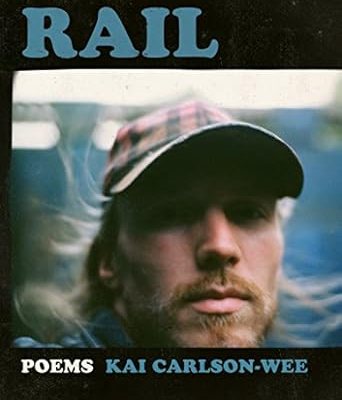

This review was originally published in The Collagist.
What home
are we leaving? What distances blur
the electric fence? What hundred low thundering
wheels of darkness are coming to carry us
there?
These lines from the title poem of Kai Carlson-Wee’s 2018 poetry collection Rail offer the book’s central questions and provide its driving visual motif; What does home mean when you’re living off what you carry on your back, and what’s carrying you is a freight train? What does all this land covered inside the belly of an empty train car mean in the context of a young life, lost and lonely and depressed but alive and searching? What is sought?
Given the symbolism of train-hopping in American culture, most works of fiction, memoir, or poetry that include this method of travel tend to paint it as a means of freedom, discovery, and countercultural expression. In Rail, Carlson-Wee is having a hard enough time keeping himself moving forward each day in a state of crushing depression to worry about what his travels mean. He’s not trying to stick it to the man or fulfill some American imperative of personal freedom; he’s trying to survive. He writes in “Mental Health,”
You count the weight of every
breath. You know it can’t go on like this. But here you
are. This is life. This is the way your day begins.
Despite the effort needed to put one foot in front of the other in a state of despair and uncertainty, Carlson-Wee does find moments to reflect on his journey across the West on the rolling steel wheels of freight trains. “The train / is my shepherd” he reflects in “Where the Feeling Deserts Us,” and he goes on to explain in the same poem why riding the rails is appealing in the state of confusion he’s in:
This is the best
I can give you for a reason—the metal accepts you,
whoever you are. The train you are riding will only
go forward. The straight line is perfectly clear.
That straight line and clear destination is contrasted with the meaningless noise and disorienting haze of suburban American life. He writes in “Depression,”
my friends are asleep
in their anticipated lives, dreaming in the vain styles
of their age, painting their childhoods
over their eyes
In “Jesse James Days,” one of Rail’s most significant poems, he looks at this possible fate in his own life and that of his brother’s, a recurring character in the book:
What grainy, impossible dreams
used to guide us. What wildernesses burned on the vacated stages
and bankrupt resorts of our brains?
Anders, we get old. We divide ourselves up into seasons,
digressions, failed attractions, glorified versions
of jaded and lost men we promised
to never become.
Beneath the thick cloud of depression, and within the empty pursuits of late capitalism, the tangible solidity of the railroad—its predictability and pragmatism, its incontrovertible physics—provides something for Carlson-Wee to anchor himself to as it rumbles across the prairie. As he writes in “After Havre,”
You can feel it going before it goes. Shivers along the connections, revived
by the engines. Five of them, suddenly pressing
their weight to the backline. Cracking along
the imaginary spine as my own bucket lurches,
and rattles toward Portland.
The immeasurable weight of the trains is referenced often in these poems, evoking the weight of depression but also the inevitability of movement, the momentum of aging, the sensation of being carried forward with or against one’s will. Rail could nearly be summarized by these two lines from “American Freight,” an extended poems that forms the spiritual center of the collection: “The weight of it. All of it. / Rolling away from its origin”.
While it would be difficult to say Carlson-Wee heals from his depression in Rail, he does perhaps gain perspective on it, and on the dysphoria of being a soul and a mind inside a body in a materialistic era. Paradoxically, it is the body that gives that perspective. The body moved and altered by industry and labor, the body sanctified by the very rot that renders it perishable. As he writes in “Holes in the Mountain,”
The scars on our hands are only around
to remind us: don’t grow old in yourself,
don’t get lost in this scrimmage
Kai Carlson-Wee is himself no lighter for having ridden the weight of a freight train, but those days and nights rolling on the broken backs of America’s rustiest metaphor for its own failed dreams did perhaps allow him to release himself, however briefly, from the spiritual consequences of mortality. Rail finishes with these lines from the same poem:
And although the soul is a joke we tell
to the part of ourselves we can touch,
it’s only because the soul is a fire, and laughs
at our sorrow, and has already survived us.
 davidnilsenwriter.com